
Faculty Development Beyond the First-Year Seminar: Making the Case for Faculty Development Centering First-Year Pedagogies
Jennifer T. Stephens, Jill McSweeney, Nina Namaste, and Brandy S. Propst, Elon University
The first year of college represents a unique time in a student’s academic and personal development, requiring pedagogical approaches that differ from those in subsequent years. Scholarship on the first-year experience supports the notion that the teaching of first-year students is inherently transition work (Cameron & Rideout, 2020; Felby & Ashwin, 2025; Keup & Penaherrera, 2022; Kift et al., 2010); therefore, the design and delivery of course content cannot be treated as simply introductory-level versions of upper-level courses. Here, we discuss explicitly naming the instructional approaches and course design work within the first-year experience as “first-year pedagogies” to emphasize unique contributions to this important period in a student’s academic experience and to acknowledge the expertise faculty and staff who teach these courses need to cultivate.
Studies on first-year seminars offer a starting place to explore first-year specific teaching and learning approaches (from here on out, we will refer to this as “first-year pedagogies”). Research on University 101: The Student in the University at the University of South Carolina (Friedman, 2022; Gardner, 1978), the National Survey of First-Year Seminars (Cameron & Rideout, 2022), and transition pedagogy (Kift, 2009, 2015; Kift & Nelson, 2005) demonstrate that effective approaches for engaging first-year students in learning spaces requires educators to explicitly teach and encourage students to practice academic expectations and institutional norms, self-regulation and metacognition, and self-directed learning strategies. In addition, educators should provide structured opportunities for building belonging across university spaces (i.e., with peers, faculty, and staff inside and outside of the classroom), academic literacies, and navigational capital. Findings from these studies provide a starting point for understanding both the critical and unique pedagogical decisions that instructors must make when teaching within these contexts.
The first-year experience extends beyond the first-year seminar and is shared across campus in spaces with high first-year student participation (e.g., introductory general education courses or gateway disciplinary/major courses). While instructor support is typically targeted at first-year seminars, these tertiary experiences are often excluded, leaving faculty unaware (and potentially ill-equipped) that their courses are an integral part of that first-year transitionary experience for many students. Thus, the faculty development found to be essential for the effective delivery of first-year seminars (Gordon & Foutz, 2015; Groccia & Hunter, 2012; Smith & Barrett, 2019; Sobel, 2014) needs to be extended to faculty involved in these additional experiences. In these un-labelled first-year learning spaces, instructors build mentoring relationships and foster pivotal impacts on students’ sense of belonging during this transitional period, consequently impacting student success, retention, and attrition indicators (Bentrim & Henning, 2023; Robinson, Seymour, Jin & Whiteman, 2025; Strayhom, 2018). Below we outline how an institutional faculty development approach centered on first-year pedagogies became a vehicle for shared values, language, and instructional and curricular practices. We saw a need to support student learning and development in the first year across explicitly labelled first-year experiences (e.g., first-year seminars) and tertiary spaces fundamental to the first-year experience (e.g., general education courses and discipline/major gateway courses), and we leveraged intentional faculty development to do so.
Case Study: FYE Faculty Development at Elon University
Elon University is a mid-sized, private, comprehensive liberal arts university in central North Carolina. Elon defines the First-Year Experience (FYE) as a constellation of courses, programs, and opportunities designed to support the academic, personal, and social transitions of first-year students. Whether leading programming around the first-year common reading, teaching a residentially linked first-year seminar or gateway major course, or advising first-year students through ELON 1010: The First-Year Advising Seminar, the number of faculty and staff involved in a student’s first year at Elon is substantial. However, until recently much of this work was done in siloes and without consideration given to creating a shared space for faculty and staff involved in one or more of these experiences, which often led to students and educators not seeing the totality of the experience nor specialization of pedagogies. Identifying a need for shared understanding, language, strategies, and commitment, Elon began a concerted effort to align and expand faculty development efforts based on first-year student outcomes.
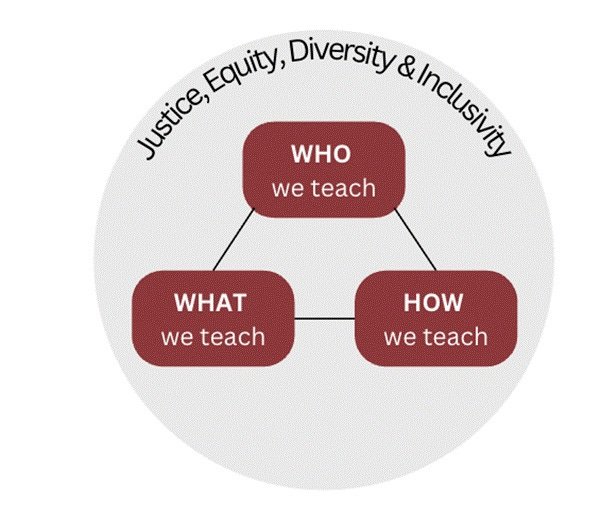
Utilizing assessment results from student, staff, and faculty surveys administered in 2023, along with literature on high-impact and inclusive teaching approaches, leadership from Elon’s Core Curriculum, ELON 1010: The First-Year Advising Seminar, Living & Learning at Elon, and Elon’s Center for the Advancement of Teaching & Learning developed an initial framework for first-year pedagogies contextualized for the culture and needs of the Elon campus community. The Elon Framework for First-Year Pedagogies (Figure 1) considered:
WHO we teach. First, we must appreciate student demographics, major population, required versus elective status, etc. of one’s course where first-years are present. This context is important because it helps center students’ needs and the scaffolding required to support students’ transitions.
WHAT we teach. Next, we need to consider the learning goals and outcomes of the course and how these goals and outcomes align horizontally with students’ other first-year experiences. At Elon, this involves contextualizing one’s course within a first-year experience that includes First-Year Foundations (seminar) courses, Elon 1010: The First-Year Advising Seminar, major gateway courses, living-learning community seminars, and a variety of common intellectual experiences integrated into campus life.
HOW we teach. We also need to think about high-impact practices; strategies for student engagement and community-building; clarifying academic expectations and institutional norms; and supporting student development in areas like self-regulation, metacognition, and self-directed learning. As an experiential learning campus, Elon instructors consider how to introduce the characteristics of experiential learning to first-year students whose expectations around teaching and learning (which they were exposed to in their pre-university experience) might differ from that of our institutional culture.
Justice, Equity, Diversity, and Inclusivity. Each of the aforementioned steps is done with a shared commitment to Inclusive Excellence at Elon. Educators engage in critical self-reflection and programming supporting the integration of the values of justice, equity, diversity, and inclusivity throughout their considerations of who, what, and how they teach.
Figure 1
Elon Framework for First-Year Pedagogies
As the team developed this initial framework for first-year pedagogies, we understood the need for educator capacity-building to successfully enact it and developed specific programming to provide this support.
A community of practice (CoP) launched during 2024-2025 to refine and expand faculty development around first-year pedagogies. The CoP strategically recruited faculty and staff as first participants to help foster collective understanding, language, and practices. This year-long CoP included workshops and discussion sessions around four specific first-year student success pillars:
Support through transitions: This includes developing student confidence and strong community.
Preparations to navigate the four-year college experience: Taking a holistic view of the FYE across all academic and non-academic experiences as students journey toward their degree.
Transformative learning: Centering purpose-driven learning and creating spaces where students feel safe-enough to be curious.
Build self-efficacy and autonomy: Scaffolding support for self-regulation, metacognition, and self-directed learning strategies.
CoP assessment data highlighted the benefits and continued need for opportunities to share institutional context, real examples from colleagues teaching first-year students, and resources to support both faculty/staff and students in navigating these transitional periods through pedagogy. Additionally, it provided tangible ways to support student success through a thriving lens, just-in-time practices and debriefs aligned with the academic calendar, and developing a first-year educator identity.
The second iteration of the FYE workshop series and CoP, offered during the 2025-2026 academic year, involved pedagogical workshops facilitated by members of the first CoP and other campus partners, with bi-weekly open-ended CoP gatherings offered during non-workshop weeks.
Fall 2025 Workshops
Understanding Our First-Year Students: Teaching with Intention. Participants gained insights into the goals of Elon’s First-Year Experience (FYE) and learned practical strategies to design courses and pedagogical approaches that meet students where they are—academically, socially, and developmentally.
Supporting First-Year Students through the Mid-Semester Slump. This session explored how faculty could create classroom environments that support students’ well-being, executive functioning, and decision-making skills in the current semester.
Empowering First-Year Students through Active Learning. In this interdisciplinary faculty panel, instructors shared practical strategies and classroom activities that foster community, support student agency, and ease the transition to college-level learning.
Spring 2026 Workshops
Sustaining Motivation and Engagement in the First-Year Classroom. The workshop offered strategies to support first-year students in becoming active, self-aware learners and support faculty in designing activities and assessments that sustain motivation beyond the excitement of the fall.
Helping First-Year Students Find Purpose and Meaning. Participants explored how to integrate wellness, meaning-making, and the liberal arts into any course—regardless of discipline—and offer strategies to help students navigate ambiguity, reconnect with their goals, and find a sense of purpose in their academic journey.
Seeing Yourself as a First-Year Pedagogue. This session focused on offering participants dedicated time to reflect on their teaching practices, share insights, and reimagine how growth and learning—both their own and their students’—can guide and enrich their work in the classroom.
Beyond
Continuing to expand faculty development offerings for instructors supporting first-year students in a variety of course types and co-curricular programs, Elon’s next iteration of faculty development offerings includes a Scholarship of Teaching and Learning book discussion, FYE teaching institute, and facilitated course and co-curricular program (re)design sessions.
Recommendations for Faculty Development
With the first-year experience extending beyond first-year seminars to other courses and learning spaces, campuses need to cast a wider net with their faculty development offerings centered on supporting first-year students. Faculty development that includes first-year seminar instructors alongside those engaged in teaching and mentorship in tertiary experiences can help create shared understanding and investment in the first-year experience across the campus community. These offerings should highlight first-year pedagogies as unique and requiring a specialized set of knowledge and skills. Additionally, institutions might consider mapping the characteristics of effective research-based first-year pedagogies with the unique cultural traditions of the campus culture and backgrounds of the student body. By extending faculty development beyond the first-year seminar, campuses can better support first-year student success through intentionally developed educators who work with shared values, language, and pedagogical and curricular design strategies.
References
Bentrim, E., & Henning, G. W. (Eds.). (2023). The impact of a sense of belonging in college: Implications for student persistence, retention, and success. Taylor & Francis.
Cameron, R. B., & Rideout, C. A. (2022). ‘It’s been a challenge finding new ways to learn’: First-year students’ perceptions of adapting to learning in a university environment. Studies in Higher Education 47(3), 668-682. https://doi.org/10.1080/03075079.2020.1783525
Felby, L. C., & Ashwin, P. (2025). Reimagining the first year experience in higher education through a focus on knowledge engagement. Teaching in Higher Education, 1-12. https://doi.org/10.1080/13562517.2025.2532461
Friedman, D. B. (2022). Key ingredients to a successful first-year seminar. In D. B. Frideman, T. L. Skinner, & C. S. Greene (Eds.), From educational experiment to standard bearer: University 101 at the University of South Carolina (pp. 76-88). University of South Carolina Press.
Gardner, J. N. (1978). How to make students more effective consumers of their education: University l0l at the University of South Carolina. Journal of Southern College Personnel Association, 1(1), 61-68.
Gordon, L., & Foutz, T. (2015). Navigating the first-year program: Exploring new waters in a faculty learning community. International Journal of Teaching and Learning in Higher Education, 27(1), 81-93.
Groccia, J. E., & Hunter, S. (2012). The first-year seminar: Designing, implementing, and assessing courses to support student learning and success: Volume two: Instructor training and development. National Resource Center for the First-Year Experience and Students in Transition.
Keup, J. R. & Penaherrera, G. (2022). How HIP are first-year seminars for developmental education and provisionally admitted students? (Research Brief). University of South Carolina, National Resource Center for The First-Year Experience and Students in Transition. https://strongstart.org/wp-content/uploads/2023/06/SStF_Research_Brief.pdf
Kift, S. (2009). Articulating a transition pedagogy to scaffold and to enhance the first year student learning experience in Australian higher education: Final report for ALTC Senior Fellowship Program. Australian Learning and Teaching Council. https://ltr.edu.au/vufind/Record/364842
Kift, S. (2015). A decade of transition pedagogy: A quantum leap in conceptualising the first year experience. HERDSA Review of Higher Education, 2, 51-86. https://herdsa.org.au/herdsa-review-higher-education-vol-2/51-86
Kift, S., & Nelson, K. (2005). Beyond curriculum reform: Embedding the transition experience. In A. Brew, & C. Asmar (Eds.). Proceedings of the 28th HERDSA annual conference (pp. 225-235). HERDSA. https://eprints.qut.edu.au/3944/
Kift, S., Nelson, K., & Clarke, J. (2010). Transition Pedagogy: A third generation approach to FYE – A case study of policy and practice for the higher education sector. The International Journal of the First Year in Higher Education, 1(1), 1-20.
Robinson, J. M., Seymour, R., Jin, S., & Whiteman, R. S. (2025). Sense of Belonging, DFW Reduction, and Student Success: Centering Student Experience in Groups with Ethnographic Methods. Education Sciences, 15(5), 523.
Smith, T., & Barrett, C. (2019). Supporting first-year seminar faculty through assets-based communities of practice. Journal of Faculty Development, 33(3), 19-24.
Sobel, K. (2018). Recruiting faculty for first-year seminars: A review of the literature. Teaching & Learning Inquiry Journal, 6, 67-78.
Strayhorn, T. L. (2018). College students’ sense of belonging: A key to educational success for all students. Routledge.
Author Note
Jennifer T. Stephens, Director of Academic-Residential Partnerships and Assistant Professor of Education at Elon University
Jill McSweeney, Assistant Director of the Center for the Advancement of Teaching and Learning and Assistant Professor of Wellness at Elon University
Nina Namaste, Assistant Director of First Year Seminars in the Elon Core Curriculum and Professor of Spanish at Elon University
Brandy S. Propst, Director of Elon 1010 and Assistant Director of Academic Advising at Elon University
Submission intended for the “Making the Case: Revisiting the Why” section of Insights.
We have no known conflicts of interest to disclose.
Correspondence concerning this article should be addressed to Jennifer T. Stephens, Elon University, 2675 Campus Box, Elon, NC 27244, United States. Email: jstephens17@elon.edu
How to cite this article:
Stephens, J. T., McSweeney, J., Namaste, N., & Propst, B. S. (2026). Faculty development beyond the first-year seminar: Making the case for faculty development centering first-year pedagogies. Insights for College Transitions, 21(3).